Technical debt is often viewed as an engineering concern, yet its consequences are felt across the entire organisation. As AI adoption accelerates and markets become more demanding, unmanaged technical debt is increasingly limiting growth, slowing innovation and reducing competitive advantage.
Generative AI has become the centrepiece of almost every technology strategy. Organisations are racing to deploy AI assistants, automate software development and improve productivity across the software delivery lifecycle. The opportunity is undeniable, but so is the misconception. AI is not a substitute for good engineering. It is an accelerator of it.
After decades of investment in cloud, data, agile delivery and now AI, organisations should be getting better at digital transformation. Yet the evidence suggests otherwise. The technology has improved dramatically. The success rate of transformation programmes has not. That raises an uncomfortable question. If the tools are no longer the problem, what is?
Most organisations now accept that technology is fundamental to future growth. Fewer have recognised that software itself has become a core business capability rather than simply an IT function. As markets become more digital and AI transforms technology, organisations with a software-centric mindset will outperform those that see software as just an IT function.
Digital transformation has never attracted more investment, yet organisations continue to struggle to convert technology spending into lasting business value. The problem is no longer confined to IT departments. It has become a question of economic competitiveness, organisational resilience and leadership.
Most organisations understand where the industry is heading. They understand the potential of AI, the importance of data, the need to modernise technology estates and the opportunities created by automation. The challenge is no longer one of awareness. The challenge is turning those ambitions into operational reality. This ...
We’re proud to see Transform! co-author and Digiterre CEO Ian Murrin featured in CEO Magazine, with his latest article: The Hidden Technology Holding Up Modern Life. In the piece, Ian explores the often-overlooked systems that quietly power today’s digital economy—technology that, while rarely visible, is absolutely critical to keeping industries moving and ...
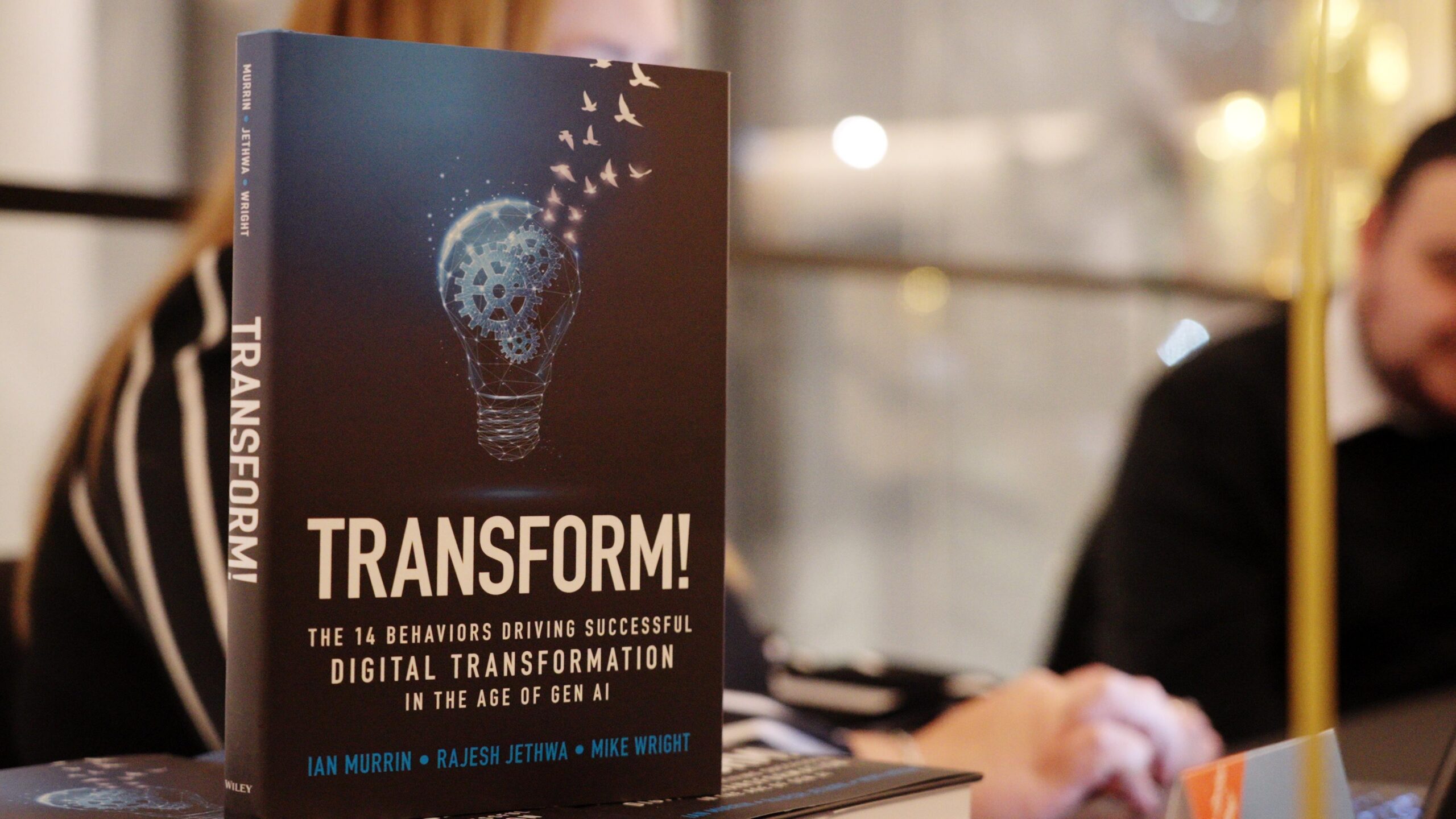
Transform! The 14 Behaviors Driving Successful Digital Transformation in the Age of Gen AI has been gaining recognition across a range of respected business and technology publications. From curated book roundups to expert commentary on AI regulation, the coverage reflects the growing interest in practical guidance for organisations navigating transformation in the age of generative […]
As organisations race to adopt artificial intelligence and rapidly evolving digital capabilities, the authors argue that success depends less on technology itself and more on how leaders, teams, and organisations behave during periods of change. The book outlines fourteen practical behaviours that help businesses navigate transformation, scale innovation, and deliver lasting value. The release comes [&...
This year marks a major milestone for Digiterre: 25 years of innovation, growth, and partnership. Since its founding, Digiterre has been driven by a simple but powerful idea: Technology can solve complex problems and help organisations move faster, think smarter, and build better futures. Over the past quarter century, that belief has shaped the company’s [&...
C++ has long powered Tier 1 banks’ high-performance systems, but growing demands for agility, security, and modern integration make its modernisation increasingly urgent.
Recent cyber-attacks on major retailers have highlighted for financial services firms the urgent need to modernise outdated systems and strengthen security to protect sensitive data.